Only 11% of 350 Agency Brands Advertise Client AI Systems and Support
Original agency research. What a client can buy, what an agency has to build, and where I would look for the next useful offer in 2027.
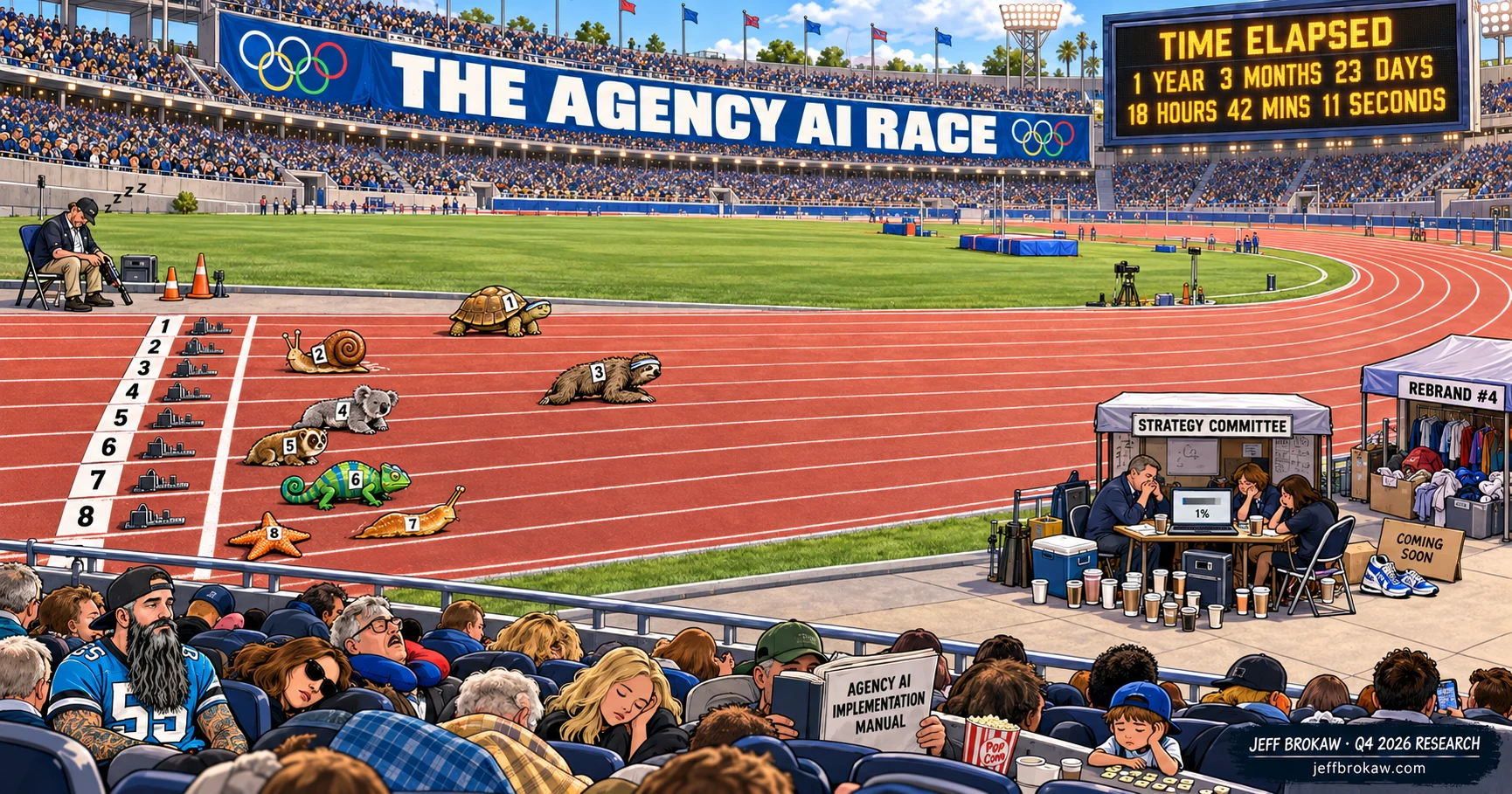
If your AI proposal reads like a software shopping list, I'd buy the software.
The client can find the tools. I want to see why the agency chose them, which problem it fixed and what happened when people started using the result.
In my October review of 350 selected agency brands, 39 explicitly advertised both client AI systems and AI operating, monitoring or governance services. That's 11.1%, rounded to 11%.
Traction's June 2026 account of its work for Patiofyre is a more substantial offer than access to another tool. It describes a client marketing engine connecting company information with Shopify, email and the team's working applications. The agency also explains how its own strategy system uses customer interviews and expert review.
That is work a buyer can examine. It points to an offer an agency could develop for 2027: choose a client problem the team understands, build or configure a useful system around it, and explain who checks the result.
What can marketing agencies offer beyond access to AI tools?
A client AI system is AI software the client's staff or customers use directly, built or configured by the agency. Agencies can help the team use it reliably. The examples here include a connected marketing engine, a formatting process in Google Workspace and a tourism assistant. Useful implementation requires accurate information, output testing and clear responsibility for review and updates. Its value depends on whether the work improves the client's process or customer experience.
What the 11% measures
The 350 brands were a selected roster, not a random sample of the agency industry. They include different business models, including marketing-technology and CRM/RevOps specialists; this is not a sample restricted to advertising agencies. They were reviewed in October 2026 across six overlapping categories of publicly advertised AI-related services.
Two categories form this article's finding:
| Public offer recorded | Agency brands | Share of all 350 |
|---|---|---|
| Client-facing or client-operated AI systems | 68 | 19.4% |
| AI operating, monitoring or governance support | 60 | 17.1% |
| Both categories, counting each brand once | 39 | 11.1% |
The last row is the intersection. It isn't the first two rows added together, and it isn't a count of proprietary AI products.
An advertised client system could involve configuring existing software or building an application. The support category could describe operations, monitoring or governance. Those activities aren't interchangeable, and the records don't establish a specific service package for all 39 brands.
I would not turn this into “89% of agencies can't implement AI.” Missing public evidence doesn't establish missing capability. Some work is confidential. Some agencies may provide it without a dedicated page. Some category checks remained unresolved.
The broader offer breakdown, including AI search, is in the first article in this series. This article examines what the implementation and operating offers look like when agencies explain them.
What does AI implementation from a marketing agency look like?
Traction's Patiofyre case describes a custom marketing engine for a fire-pit brand. In its June 18, 2026 explanation, the agency says Fyrestarter connects 34 agents to Shopify, Klaviyo, Figma, Google Drive and Slack. It uses brand information and can produce plans, reports and campaign material. The account describes a workflow for approving blog content before publication to Shopify.
Traction separately describes its internal TractionOS strategy system, where customer interviews inform the work and expert strategists review stages before the next workflow activates. That is a different system from the client implementation, so I would ask to see the actual approval and monitoring process for the proposed client build.
The agency reports a 3X return on ad spend for Patiofyre. The pages don't provide enough measurement detail to establish what the AI system caused, or turn that result into a forecast for another business.
The agency's account gives a buyer an implementation to investigate. Which company information does it use? Where does it connect? Which outputs require approval? Can the client team use it without reconstructing the context in every new chat?
Those questions get closer to the work than a list of model logos does.
How should an agency prove AI work affected revenue?
A marketing engine can help a team prepare and execute work. A reported return on ad spend can help explain campaign performance. Before using either to justify more investment, I would want to understand the comparison.
For Patiofyre, I would ask which period the 3X covers, what revenue and media costs were included, and what else changed in the campaigns. A business also needs the product and operating costs before treating a return on ad spend as a profit figure.
A system can produce more material without improving demand. It can also remove manual work that was stopping a small team from doing useful marketing. Establish which change the client needs before deciding what to automate.
For an implementation project, I would preserve examples of the old work and test the proposed replacement against them. If the claim is faster execution, compare the time and review effort. If it is better lead handling, follow the records through the sales process. If it is additional revenue, use a credible comparison and account for other changes.
Where practical, a randomized holdout gives a stronger comparison than a simple before-and-after chart. When randomization isn't possible, differences in customer mix, timing, sales coverage and the offer still need checking. Proving AI Pipeline to Your Board goes further into that problem.
Cost needs the same care. Keep model and platform consumption alongside the people configuring the system, reviewing output and handling exceptions. My cost-per-customer article covers why the job and the customer need a traceable cost record.
Other agencies putting AI inside client work
These agency-published accounts show different client tasks and delivery requirements.
Content Workshop: tools inside the client's Google Workspace
Content Workshop's Palo Alto Networks case describes custom Workspace applications and Gemini Gems developed during a pilot to address a formatting-heavy workflow. The agency reports substantial time savings, though the page doesn't explain enough of the measurement to treat those savings as independently established.
The team built around an existing working environment and a specific task. For an agency, that opens a conversation with the people doing the work about which step consumes time and what a usable replacement would require.
WebSpero: an assistant with a defined information source
WebSpero's ChatNT account describes a tourism voice assistant using campaign information, retrieval and a classifier that checks whether messages belong within its subject. The agency says a three-developer team delivered the project in about a month.
A public assistant requires a different level of testing from an internal formatting tool. I would want to see what it does when the source information is incomplete, when it misunderstands the visitor and when a question needs a person. Those are questions to test, not failures my review established.
A model upgrade would have missed the problem in my own work
I've been building AI systems commercially since 2016. On an electrical-distribution quoting product where I served as Chief AI Officer, sales reps could spend weeks preparing a large quote. The product had to extract customer requests, interpret terminology and find suitable products in a large catalog.
The application was sending unfiltered catalog information to a model. A typical query carried roughly 82,000 tokens. I wrote the rebuild roadmap around filtering and retrieval before the model saw the candidates, with exact part-number lookups able to bypass the model.
The decision required understanding the product, the information and the way a rep needed to use the result. A different model alone would still have been receiving the wrong amount of data.
That experience shapes what I look for in an agency's AI offer. Which part of the client's business do they understand well enough to change? Can they explain what information is needed, what should happen automatically and where someone needs to review the result?
Three questions your agency's AI offer should answer
An agency can explain its architecture in detail and still leave the buyer unsure what they are getting. I would make these questions part of the conversation:
- What is your agency adding beyond access to the tool?
- Will this make our team's job easier, or give them another job?
- What result would make us pay you again?
The answers depend on what the agency is selling. A custom build, a managed AI service and a tool supplied with implementation or support create different responsibilities. This research did not separately count software resellers.
A client may never log into the tool behind a managed service. They still need to understand what the agency handles, what their own team has to do and how the delivered work gets used. For adoption, have the people receiving the work try it in their actual process. Watch what they have to repair or repeat.
For the last question, agree on the result before the pilot. It could be less manual work, a faster usable response or a change later in the sales process. Show how you will check it before making a revenue claim.
What AI services should agencies build in 2027?
Make one existing service more useful to the client
An agency that already handles lead generation can examine what happens after an inquiry arrives. A content agency can examine the briefing, approval and update process. An ecommerce agency can look at whether product information supports the recommendations and buying experience it is trying to improve.
Choose a problem the team understands and can observe. Adding an AI offer creates little value if the agency can't explain which part of the client's work gets better.
Decide which implementation the team can responsibly deliver
Sometimes configuring an existing product is enough. Sometimes the information needs repair first. A custom application or specialist partner may be appropriate when the requirements exceed the agency's capabilities.
The choice should follow the job. A team can build reusable expertise around a specific platform or business process without pretending it can deliver every kind of AI system.
Put review and operating responsibility in the offer
Explain who checks the output, who can approve changes and who responds when the information or a dependency changes. Some clients will operate the system after training. Others will want continuing help. Either arrangement needs people who can carry out the responsibility.
That is more useful to a buyer than a vague promise of ongoing optimization. Who Owns an AI Marketing Decision? covers how to assign that authority, and my human-review article examines what the reviewer needs to check.
Show the work before claiming the result
Publish enough of a case for a buyer to understand the task, the configured tools, the review process and the outcome measured so far. Protect confidential information and describe the work accurately.
A reported result still needs a period, a comparison and an explanation of the other work involved. Give a prospective client enough detail to judge it before using that number to sell the next engagement.
One offer an agency could test with an existing client
For an agency already generating inquiries, I would consider a pilot around one broken lead handoff. Follow one form submission into the client's CRM: what information arrives, how the inquiry is assigned, what the salesperson receives and how the reply is prepared. Choose the part the client can identify as a recurring problem.
Use the CRM the client already has where it can handle the task. Test the proposed change on approved examples before live records. Have a named person check incorrect assignments and draft replies, with the authority to pause the workflow. Keep failed cases so a correction can be tested before it is used again.
Measure what that pilot can reasonably establish: time to a usable handoff, manual sorting work and the proportion of inquiries Sales accepts. Follow later outcomes separately. A faster reply won't prove more revenue in a week.
In the October 2027 research update, I will recheck both advertised categories against this year's 39-of-350 baseline and look for published accounts of what agencies delivered. I expect the share advertising both to increase. I will report changes in the original roster, inaccessible evidence and new examples separately so a change in the sample cannot masquerade as a change in the market.
Your client can buy the software. They're paying you to know what to do with it.
Frequently asked questions
What does the 11% figure mean?
In my October 2026 review, 39 of 350 selected agency brands explicitly advertised both client-facing or client-operated AI systems and AI operations, monitoring or governance services. That's 11.1%, rounded to 11%. The offers could be separate, and the count doesn't prove an agency supports each system it builds.
Should an agency build custom AI or configure existing tools?
Configure existing software when it can handle the client's task, information and review requirements. Consider a custom build when the business needs connections, an interface or behavior the existing products cannot adequately support. Compare the setup effort, licensing, ongoing operating work and the team's ability to maintain it before choosing.
Do agencies need a proprietary AI model?
No. Published examples in this research use existing platforms and models. The agency's work can involve choosing the application, preparing information, configuring or building the system, and establishing review and operating responsibilities.
What should ongoing AI support include?
The scope depends on the system. It may include reviewing output, checking information and connections, testing updates, investigating failures and helping users. The offer should explain who performs the work and which changes require approval. The research's support category also includes governance services, which can be a separate offer.
How can an agency connect AI implementation to revenue?
Define the business change being tested, measure the relevant workflow and follow comparable customers into later sales outcomes. Where feasible, use a randomized comparison. Report consumption and operating costs, and distinguish observed activity from evidence that the intervention caused additional revenue.
Does the research show that the other 89% cannot deliver client AI systems?
No. The study records public offers from a selected roster. Brands outside the 39 may advertise one category, provide services privately, or have unresolved evidence. The result describes what was found publicly and cannot establish the full capabilities of the other brands.
Method and sources
The research reviewed 350 selected agency brand websites in October 2026 across six overlapping AI-related offer categories, including AI search. The roster is not a random sample and may include brands with a common owner. Review states distinguish explicit offers, other observed work, bounded searches where no qualifying offer was found, and unresolved evidence. Counts describe public evidence, not verified sales, deployment quality or industry market share.
The 39-brand finding is a deduplicated intersection of the client-system and operating/monitoring/governance categories. Agency case-study claims are attributed to their publishers. There was no independent deployment testing in this review. The full research report is unpublished.
- Jeff Brokaw, Marketing Agency AI Report, October 2026, offer-review records.
- Traction: Patiofyre marketing engine.
- Traction: June 2026 implementation account.
- Content Workshop: Palo Alto Networks.
- WebSpero: ChatNT.