62% of Marketing Agencies Offer AI-Related Services. Why Hire Yours?*
An October 2026 review of 350 selected agency brands. What clients should expect beyond an AI label, and what agencies can charge to deliver.
Your client can buy an AI subscription before your proposal gets approved.
They can also buy a tool that tracks where their brand appears in AI answers. If your proposal stops at access to the software and a monthly export, expect them to ask what the agency fee covers.
Give them an answer before they ask.
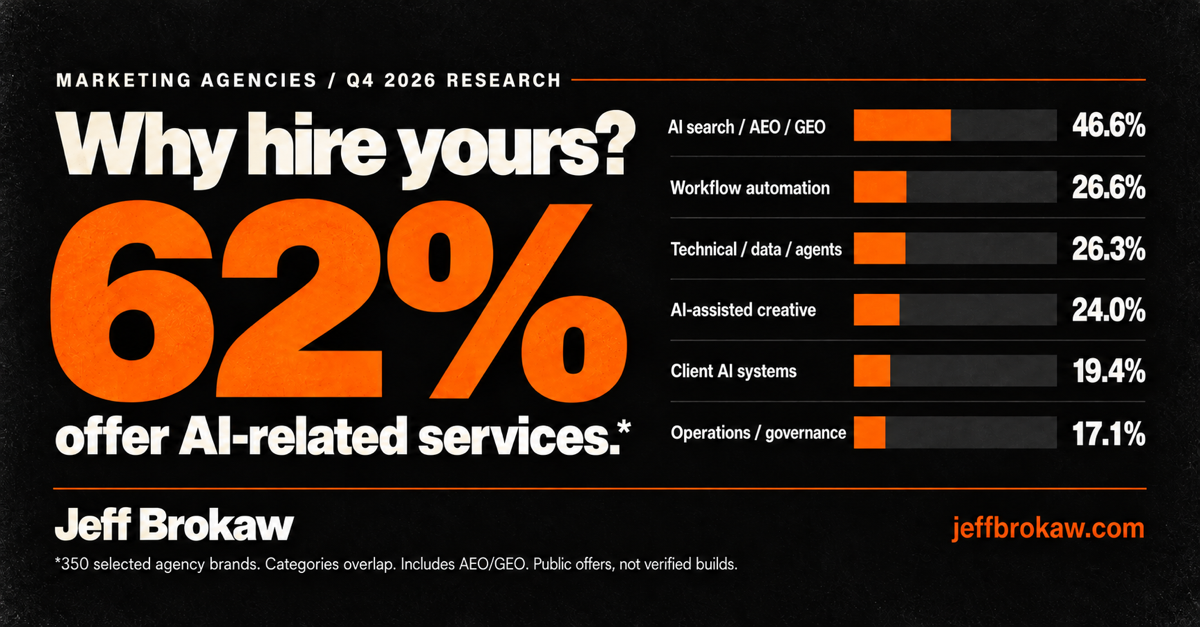
In my review of 350 selected marketing-agency brands, 62% advertised a service within the report's broad AI-related categories. That includes AEO and GEO: work intended to improve a company's visibility in AI-generated answers. It also includes creative production, automation, integration and client systems.
It does not mean 62% built AI tools.
The services behind that number are different enough that a buyer could receive an audit, a translated training deck or a working application. Those purchases involve different work, costs and responsibilities.
Why hire an agency when you can buy the AI tools?
An agency earns its fee when it can do work the client cannot or does not want to manage: choose the right problem, prepare the information, configure or connect the software, check the output and keep the process useful. The buyer should be able to see which parts the agency will handle and how the work affects a business result.
What the 62% actually covers
AI search was the most common advertised category in the roster. It appeared at 46.6% of the reviewed brands.
Here is the full offer map:
| Advertised service category | Share of the 350 reviewed brands |
|---|---|
| AI search, AEO or GEO | 46.6% |
| Workflow automation | 26.6% |
| Technical integration, data, retrieval or agents | 26.3% |
| AI-assisted content or creative | 24.0% |
| Client-operated or client-facing AI systems | 19.4% |
| Operating, monitoring or governance support | 17.1% |
Categories overlap. A brand can appear in several rows, so these percentages cannot be added. They describe advertised offers in a selected roster, not independently tested delivery.
Even within the group advertising AI-search services, almost half also advertised workflow, technical/data or client-system work. That creates possible routes from a diagnosis to implementation. It does not establish that the services are sold together or delivered by the same team.
An AEO engagement might identify missing product information. An editor could fix a page. But if a product feed overwrites it a week later, someone has to correct the source or change the feed.
A recommendation to improve response speed could require a better form, a change in the CRM or a connection to the right product data. None automatically requires custom AI software.
An agency that knows the account can help choose the appropriate fix. It needs to say whether it will deliver that fix, manage a specialist or leave the client with recommendations to implement elsewhere.
AEO is a service. It doesn't mean you built the AI.
Helping a client appear in AI answers can be useful work. It involves a different promise from building a system that the client operates.
Take prompt selection. A business doesn't benefit equally from every mention. Being recommended for a service it doesn't provide can create enquiries the sales team cannot use. A competitor appearing for a buyer the business wants is a different problem.
Choosing the right buyer questions, identifying weak source material and deciding which pages deserve work require knowledge of the account. I worked through that decision in Sometimes Your Competitor Should Get the AI Recommendation.
A tracking platform can support the job. Peec AI, for example, lets teams organize monitored prompts and examine visibility across models, countries and tagged groups. A client can buy that software.
The agency still has to choose a useful prompt set, interpret what appeared and decide what to do next. If it recommends a page change, someone has to write, approve and implement it. If the finding points to an offer or product limitation, another article may not be the answer.
The proposal should make those responsibilities visible. A reporting-only engagement can be legitimate when both parties understand the purchase. It becomes harder to defend when the buyer expects the fee to include fixing everything the report identifies.
Using somebody else's model can still involve substantial work
An agency does not need to invent a language model to deliver something worth buying.
PUSH's translation work for The Stress Management Society gives a specific example. The agency describes a Claude Skill operating inside the client's own organization. It extracts text from English Canva training decks, translates it into language copies and checks formatting. Local trainers review the text, and the original deck design stays intact.
PUSH says the workflow has been live since August 2026, with local trainers continuing to review the translations.
A client can buy Claude. They may still want someone to configure a repeatable process around their material, terminology and reviewers, then train the people who use it. That is work an agency can explain and price.
WebSpero's Vatrina account describes a more involved build. The shopping assistant retrieves product information, checks stock through live functions and passes unresolved conversations to a person with the context attached. Its architecture uses PostgreSQL with pgVector and OpenAI.
The described work connects recommendations to inventory and provides a handoff when the system cannot resolve a request. Both cases are supplier-published accounts, not independent performance tests.
I'd ask either team to demonstrate an exception as well as the successful path. Show a translation that needs correction. Show what a shopper sees when stock changes or a person has to take over.
Those demonstrations help a prospect understand the work they are buying.
Some jobs need more than a subscription
On an electrical-distribution platform I helped rebuild as Chief AI Officer, sales reps could spend weeks preparing large quotes. A request could arrive as an email, a detailed bill of materials or a drawing. Manufacturer terminology, customer language and thousands of similar products made matching difficult.
We used Google Cloud Document AI to extract manufacturer specifications, normalized catalog descriptions and filtered candidates before the language model saw them. The system searched hundreds of thousands of products and prepared customer-priced quote lines with alternatives and supporting spec sheets for review. An Outlook add-in let reps begin from the email already open.
The product was prelaunch. I'm not using it as evidence of realized customer revenue. It illustrates the engineering and commercial decisions behind a quoting workflow that a model subscription alone would not deliver.
An agency can pursue work of that depth if it has the people to do it, or manage a suitable partner. It can also choose a smaller job. Connecting an existing form to a reviewed response process may be more useful to a particular client than commissioning a new application.
I would make that choice from the client's requirements and the continuing cost, rather than a desire to put another product name on the website.
A branded dashboard doesn't settle what the agency built
The report's product catalog contains 128 named records. Those include related offerings and components; they are not automatically 128 independent software platforms. The research identifies 34 supported relationships between broader offerings and their components.
A module name does not establish a separate product. A system running in the client's account does not establish that the client owns the application code. An agency's internal tool can improve delivery without being available for clients to buy.
For the buyer, the practical question is what they can keep using. If a workflow depends on an agency-managed account, someone needs to maintain that account. If the client expects to operate it themselves, the handover needs usable access and instructions. Those are different purchases from a monthly report.
Describe the software or service being sold, name outside dependencies and show what the agency added. Price the continuing work before promising the handover.
For an automation project, a platform such as n8n can connect model providers and workflow components. The agency may contribute the process design, data mapping, approval steps and exception handling. Those contributions should be demonstrable without claiming ownership of the underlying platform.
I would also separate the decision to keep a useful internal tool from the decision to sell software. Clients using a product will need support, changes and an understandable way to continue or leave. Product development creates obligations that a successful internal experiment may never have faced.
A result needs enough detail to influence the next purchase
Among the records with qualifying service offers, 41.0% had documented client AI work in the pages reviewed. For 38.7%, a completed review found no example. Another 20.3% remained unresolved.
Those are public-evidence findings. Confidential work may be absent, and an unresolved record is not a verdict on capability.
If an agency has relevant work, it should make that work easier for the prospect to assess. My earlier article on agency AI proof covers the people and dated contributions to show in a proposal. The commercial question here is what the example supports buying next.
A separate part of the research examined 24 selected AI/ML-delivery case groups. Thirteen reported at least one measured client outcome. Two supplied numeric starting and ending values for at least one metric. All thirteen accounts were agency-published.
The AI-search cases were counted separately: 32 of 39 selected groups reported a measured outcome. A visibility percentage and a customer conversion rate measure different things, and neither becomes more useful by placing them in the same ranking.
A buyer needs the definition, period and comparison. If content, prices, targeting and the website changed together, describe the changes. The result may support the combined program while leaving the model's individual contribution unknown.
For a sales workflow, I'd follow comparable requests into usable responses, accepted offers and completed orders. Then I'd examine gross profit and the cost of handling the business. Faster processing is useful, but it does not establish incremental revenue.
That is the discipline behind Proving AI Pipeline. It also gives the agency a better renewal conversation than another screenshot of a rising line.
Price what happens after the first successful run
The report's public pricing examples describe different purchases. Reboot advertises an ongoing GEO program. Re:signal describes a fixed discoverability audit. ROASTWriter offers technology with setup and self-managed subscription pricing.
Those prices cannot produce a meaningful average fee for AI. The work and continuing commitments differ.
Before setting a fee, I'd want to know what the agency will still be doing when the client has used the system for a month. Review time, vendor usage, exceptions, source changes and support belong in that calculation. If the proposal promises a maintained workflow, someone has to monitor it and respond when a dependency fails.
The client may reasonably pay for that continuing work. The agency needs a defined commitment and a price that covers it.
Metering cost per customer matters when usage varies between accounts. Provider charges are one part of delivery cost. Human review and support can also grow with use, even when the model calls remain inexpensive.
A flat fee may work for a bounded service. A usage component may fit variable consumption. Either needs a clear explanation of what is included and when extra work requires approval.
I'd compare actual delivery cost with revenue after the first engagement. A proposal estimate is a starting point, not a margin result.
What I'd fund for 2027
I'd test a specific service with an existing client before building a broad AI menu.
For a search agency, one candidate is an AI-search engagement with a clearly priced implementation route. Choose commercially relevant questions, diagnose the gaps and specify which corrections the agency will make. Bring in a specialist where the necessary data or engineering work exceeds the team's capacity.
For a team already handling recurring production, I'd examine the steps that consume time without requiring a fresh creative decision every time. PUSH's translation account shows one possible job. It still needs suitable source material, a competent reviewer and enough repeat use to justify setup.
For an agency close to a client's sales process, I'd examine a recurring request that waits on information. It could be qualification, product information or quote preparation. Establish the existing delay, the permitted data access and the person who will handle exceptions before choosing software.
These are offers I'd investigate. The research does not establish demand for them or tell us which would make the best margin at a particular agency.
My 2027 prediction is that more buyers will ask the agency identifying the problem to help finish the work. That can create an implementation or managed-service opportunity. It can also be a reason to partner rather than hire a development team.
I'll revisit that prediction in October 2027. A comparable review can show changes in public offers and project accounts. Claims about profitability or retention will still need actual operating evidence; more service pages will not settle them.
I'd authorize one paid engagement with a defined acceptance check and a delivery-cost limit. If supporting it takes more time than we priced, I'd change the scope or price before offering it to the next client.
Frequently asked questions
What does the finding that 62% of agencies offer AI-related services mean?
In the selected 350-brand roster, 62% advertised at least one qualifying service in six broad categories, including AEO/GEO. The finding concerns public offers. It does not mean 62% built AI tools, own language models or have independently verified deployments. The full method note below explains the selection and review.
Is an AEO agency the same as an AI development agency?
No. AEO services aim to measure or improve visibility in external AI answers. AI development concerns a system or application someone builds, configures or maintains. An agency may offer both, but an AEO page alone does not demonstrate software development. Ask what the proposed engagement delivers.
Why hire an AI marketing agency if the client can buy the tools?
An agency can provide problem selection, account knowledge, data preparation, integration, review and continuing operation. Those contributions need to fit the client's requirements and justify their cost. Buying software may be sufficient when the client has the capacity and expertise to manage the work itself.
Does an agency need proprietary AI technology to provide value?
No. An agency can configure existing products or connect them to a client's information and process. Explain the agency's contribution, the outside dependencies and what the client receives. A proprietary label alone does not establish quality, adoption or a better commercial result.
What should an agency include in an AI-services proposal?
Define the client's task, deliverable, stage, agency contribution, dependencies and responsible people. Include an acceptance test, a measurement plan and the price's boundaries. Explain continuing support and handover. Give the prospect relevant evidence before questions about the work become objections.
How should a client judge an agency's claimed AI results?
Check the metric, baseline or comparator, time period and other changes made during the project. Distinguish visibility, speed and production measures from revenue. Agency-published results can be useful evidence, but do not automatically establish independent verification or the effect attributable specifically to AI.
Research method*
The October 15-20, 2026 public-evidence review covered 350 selected agency brand/domain records, not necessarily independent corporate groups. The 62% is 217 qualifying records divided by 350. A record qualified when a reviewed source advertised a specific service in at least one of six categories; a passing mention of AI was insufficient. Selection was nonrandom and weighted toward digital, SEO and paid-media agencies. Categories overlap. Client-work percentages use the 217 qualifying offer records as their denominator. The 24 delivery and 39 search case groups are separate populations. Public evidence does not establish unadvertised capability, industry adoption, buyer demand or agency profitability. The underlying report remains unpublished.
Sources
- Jeff Brokaw, The Marketing Agency AI Report, October 2026: offer map, client-work review, case groups, product/dependency research and commercial observations. Unreleased research; method above.
- PUSH: Claude translation workflow for The Stress Management Society.
- WebSpero: Vatrina shopping-assistant case study.
- Peec AI: AI-search analytics and segmentation.
- n8n: AI workflow documentation.
- Reboot: GEO services, Re:signal: AI-search audit, and ROASTWriter: technology and service options.
External pages checked October 22, 2026. Supplier accounts are attributed; they have not been independently tested here.