350 Agency Brands. What AI Work Do They Advertise?
A public-evidence review of 350 selected agency brands found 217 advertising AI-related services. The most common offer was AI search. Client systems, workflow automation and operating support were counted separately.
An AI-search audit and a client-facing application are different purchases. This research separates the services agencies advertise, the client work their sources describe and the results their case studies report. It gives agency leaders and buyers a way to examine those promises without treating every mention of AI as the same business.
Review window: October 15 to 20, 2026. This is a selected roster of brand/domain records, including marketing-technology specialists. It is not a representative industry survey or a ranking of agency capability.
What did the review find?
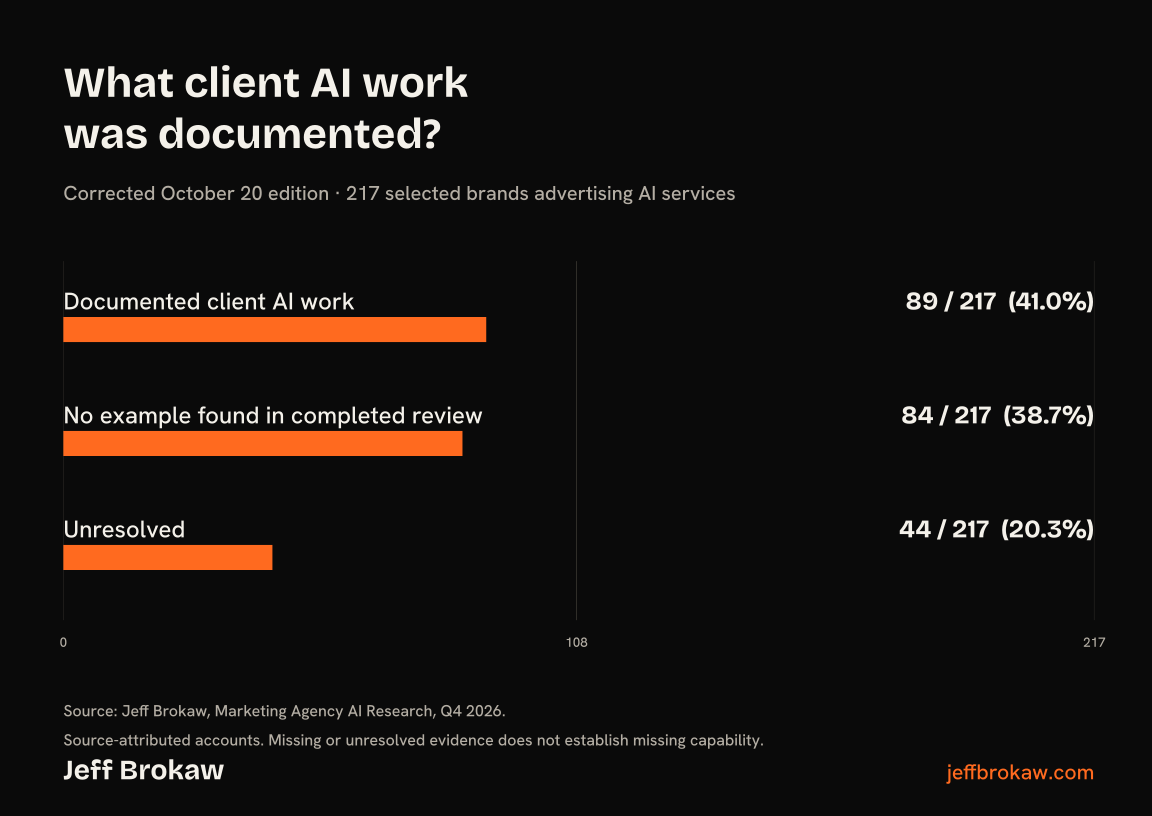
Of the 350 selected agency brands, 217 (62.0%) advertised at least one qualifying AI-related service. AI search, AEO or GEO appeared at 163 brands (46.6%). Among the 217 AI-service advertisers, reviewed sources documented client AI work for 89 (41.0%); 84 completed reviews found no qualifying example, and 44 records remained unresolved.
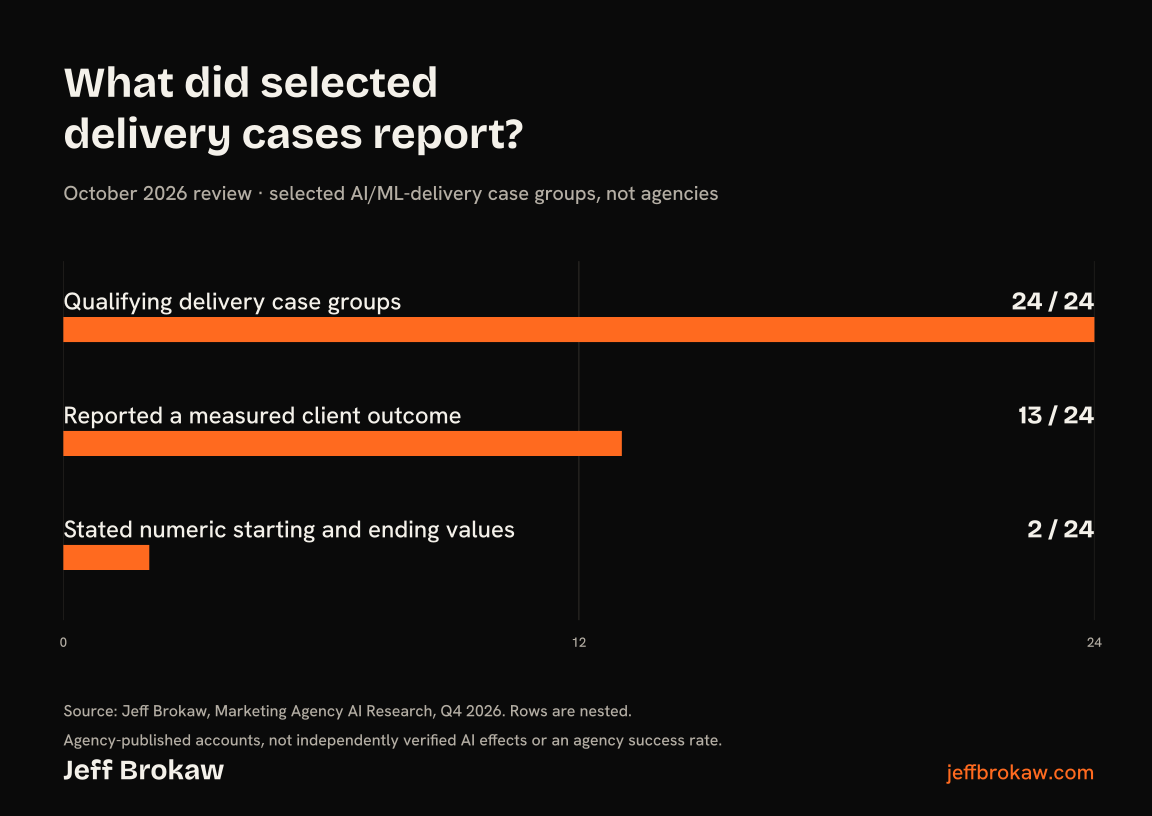
A separate review retained 24 AI or machine-learning delivery case groups. Thirteen reported a measured client outcome. Two stated numeric starting and ending values for at least one metric. These case groups are a different population from the 350 brands and the 217 offer records.
Which AI services did agency brands advertise?
Each brand was assessed against six service categories. A brand can advertise several, so the rows overlap. The counts below describe explicit public offers; the uncounted portion of a row includes several evidence states and cannot be read as proof that a service is unavailable.
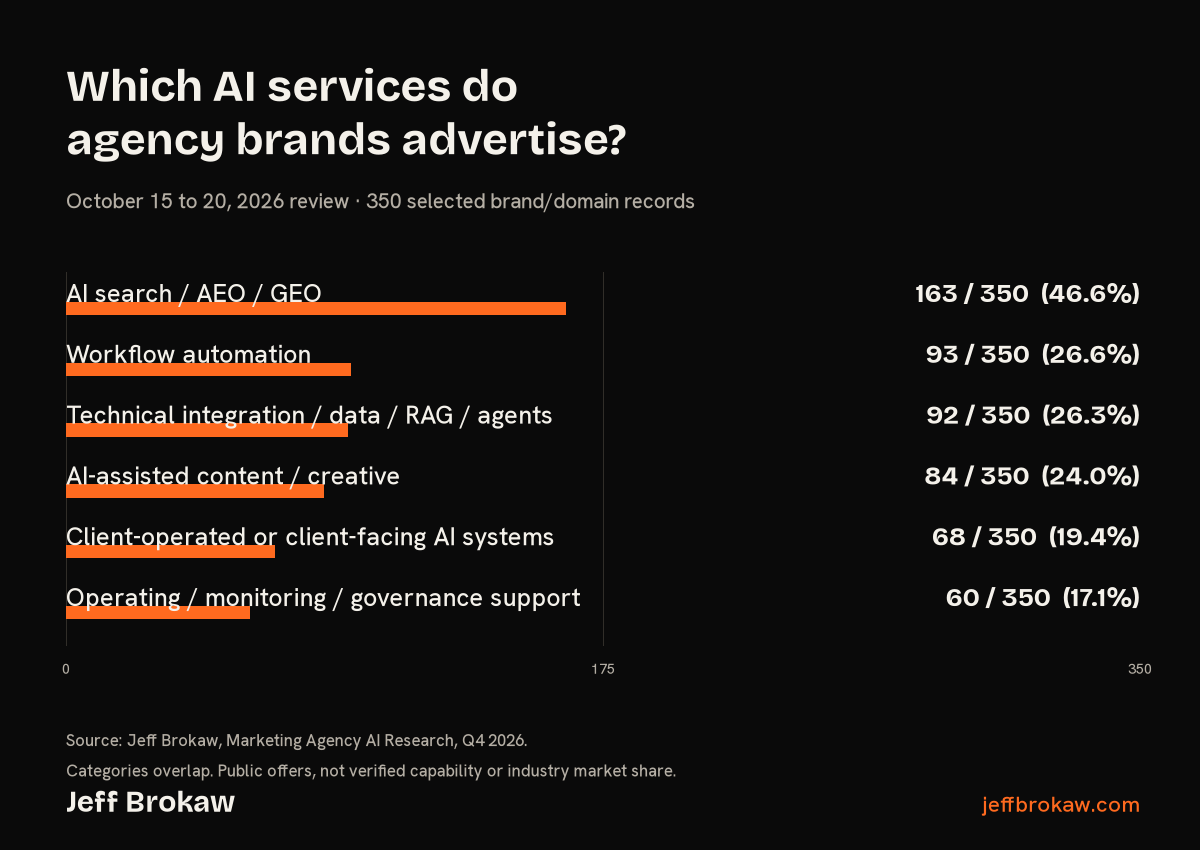
| Service category | Brands | Share |
|---|---|---|
| AI search / AEO / GEO | 163 | 46.6% |
| Workflow automation | 93 | 26.6% |
| Technical integration / data / RAG / agents | 92 | 26.3% |
| AI-assisted content / creative | 84 | 24.0% |
| Client-operated or client-facing AI systems | 68 | 19.4% |
| Operating / monitoring / governance support | 60 | 17.1% |
Thirty-nine brands advertised both client AI systems and operating, monitoring or governance services: 39 of 350, or 11.1%. That intersection does not establish that the agencies support the particular systems they build. The research did not test their operations or classify every brand as a custom builder, a software configurator or a reseller.
AI search was the largest observed category. The roster's selection favors digital, SEO and paid-media businesses, which matters when interpreting that result. These percentages are not agency-industry market shares.
How much client AI work was publicly documented?
The client-work check covered the 217 brands with an explicit AI offer. It required a source to connect a client context, an AI action and the agency's contribution. Naming an AI-capable vendor was insufficient.
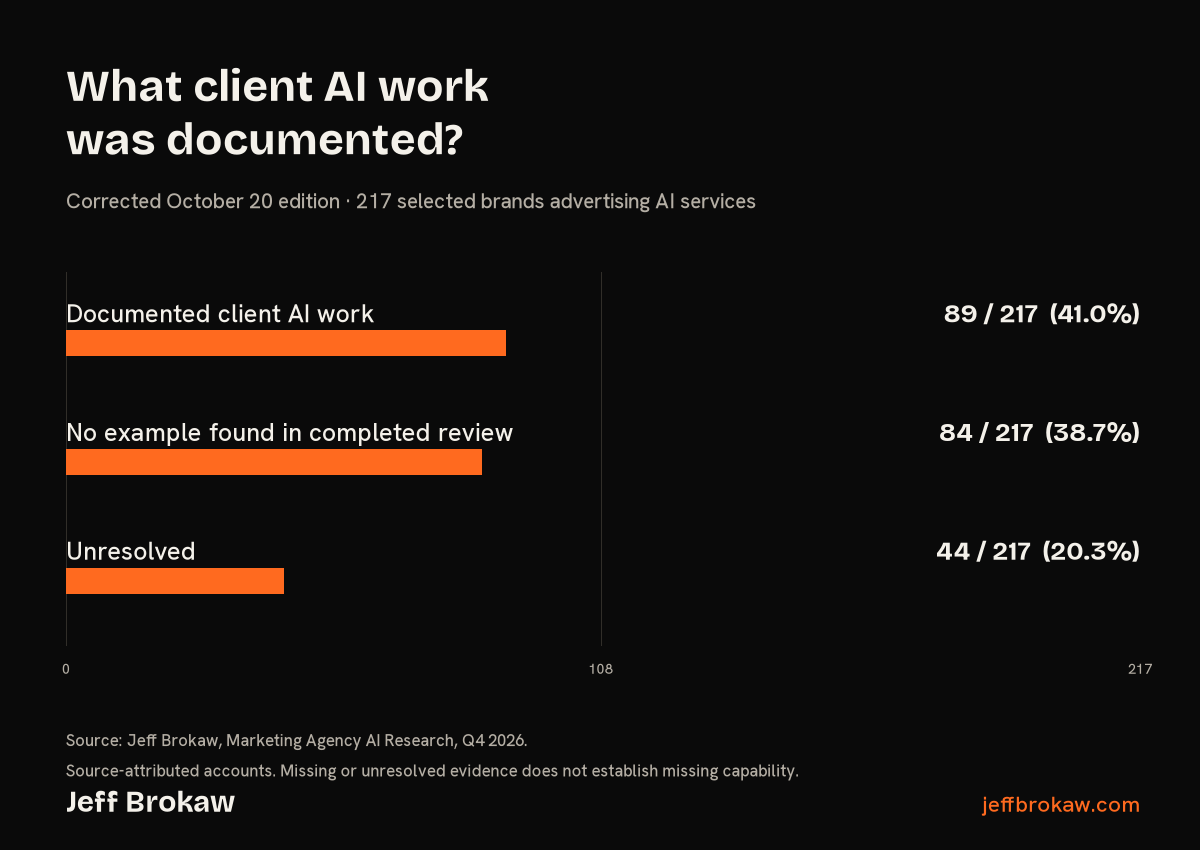
| Review finding | Brands | Share |
|---|---|---|
| Documented client AI work | 89 | 41.0% |
| No example found in completed review | 84 | 38.7% |
| Unresolved | 44 | 20.3% |
A documented example is a source-attributed account, not an independently verified deployment. An anonymous but specific client workflow, historical machine learning, platform configuration or preparatory creative work can qualify. An agency's internal tool or a person's personal build does not become client delivery by implication.
“No example found” is limited to the completed review route. “Unresolved” preserves uncertainty about required material or attribution. Neither means the agency lacks the capability or does no confidential client work.
What does documented agency AI work look like?
Two examples from the selected delivery accounts show why the agency's specific contribution matters.
PUSH: translation inside the client's workflow
PUSH describes a Claude Skill for The Stress Management Society that translates Canva training decks inside the client's own Claude organization. A review workbook lets local trainers edit or adapt the text before it reaches the deck.
The account describes the task, where the system runs and who reviews the work. It does not establish independently measured translation accuracy or a causal revenue effect.
WebSpero: shopping recommendations connected to inventory
WebSpero describes a conversational shopping module for Vatrina that retrieves product information, uses stock data and routes suitable requests to a human. That is more specific evidence than a list of AI partners: a buyer can inspect the described inputs, behavior and handoff.
Both examples are supplier-published accounts selected to illustrate different tasks. They are not a ranking or a representative sample of agency work. Their live source pages were rechecked on November 3; that check does not update the October roster totals.
What did the selected delivery cases report?
The separate case review retained 24 qualifying AI or machine-learning delivery case groups. Thirteen, from 11 agencies, reported at least one measured client outcome. All 13 accounts were agency-published. Two stated numeric temporal starting and ending values for at least one metric.
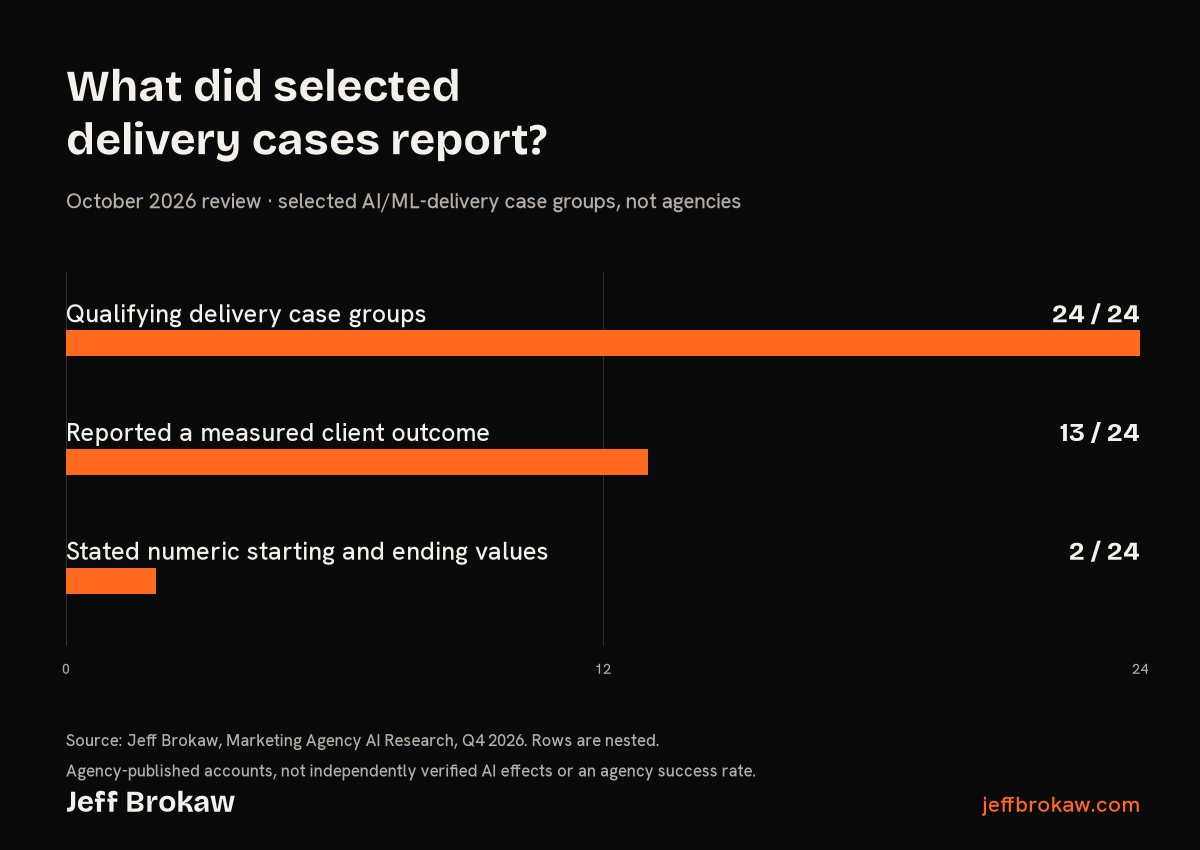
| Evidence present | Case groups | Base |
|---|---|---|
| Qualifying delivery case groups | 24 | 24 |
| Reported a measured client outcome | 13 | 24 |
| Stated numeric starting and ending values | 2 | 24 |
These counts cannot establish an agency success rate. Case groups are source-based accounts, not independently confirmed distinct engagements. Several can concern one agency, and they are not a subset or conversion funnel of the 89 documented-work brand records.
The reported results use different measures, periods and comparisons. The review did not pool them. Numeric endpoints alone do not validate a measurement; one of the two endpoint examples contains an unresolved inconsistency in its stated baseline. Campaign, creative, budget, platform and process changes can also be bundled with AI.
For a useful buying decision, ask for the metric definition, comparison, timeframe and other changes. The remaining 11 case groups include qualitative delivery, process counts, prospective or modeled values, and missing or withheld measurement detail. Their exclusion from the measured subset does not establish that the work had no value.
How was this research conducted?
Unit of review. One selected branded agency website, represented by a brand/domain record. The 350 records are not necessarily 350 independent corporate groups. The roster also includes marketing-technology and CRM/RevOps specialists.
Selection. The roster combines 260 historical records, 62 candidate records and a 28-record addendum without domain overlap. Selection was not random, and its history is only partly recoverable. One documented group came from Clutch's digital-marketing list, emphasizing digital, SEO and paid-media businesses and underrepresenting PR and creative firms. Geography, size and ownership were not uniformly verified.
Review route. The work followed official service and case-study navigation, relevant AI branches and the first three substantive case-index pages. Linked technical details, documentation and public repositories were followed within two verified link steps from each starting inventory or index, with a ceiling of 20 AI branches or cases per brand. Required material that remained unavailable or ambiguous was recorded as unresolved rather than converted into a negative finding.
Edition and dates. The review window was October 15 to 20, 2026. This summary uses the corrected October 20 client-work counts: 89 documented, 84 no example found and 44 unresolved. Later targeted discoveries are excluded from those totals because they did not give every brand the same additional review opportunity. Underlying sources can describe earlier work.
Verification boundary. There was no agency outreach, independent deployment testing or independent verification of reported business performance. Checking sources and arithmetic is narrower than replicating a measurement. This summary publishes aggregates and selected examples; it does not publish the full record-level directory.
Author disclosure. I build AI and marketing systems and have held professional discussions with agencies included in the research. The same evidence and example-selection rules apply throughout.
Download the charts and aggregate data
The downloads preserve each chart's population and evidence boundary. The CSV contains aggregate rows only, not the private agency directory or source archive.
- Advertised AI services: PNG · SVG
- Client-work evidence: PNG · SVG
- Selected delivery cases: PNG · SVG
- Aggregate data: CSV
Suggested citation
Brokaw, Jeff. Marketing Agency AI Research: 350 Selected Brands, Q4 2026. Public-evidence review conducted October 15 to 20, 2026. Summary published November 3, 2026. jeffbrokaw.com/research/marketing-agency-ai/.
When quoting a finding, keep its denominator and review period with the number. Link to the relevant section so readers can inspect the method and limits. Questions or corrections: jeff@jeffbrokaw.com.
Questions about the research
What percentage of marketing agencies offer AI services?
In this October 2026 review, 217 of 350 selected agency brand/domain records (62.0%) advertised at least one qualifying AI-related service. The roster was not random or representative, so 62.0% is a finding about this selected roster, not an industry adoption rate.
Does offering AEO or GEO mean an agency builds AI systems?
No. AI-search services concern visibility in AI-mediated answers and discovery. The review counted them separately from client-operated or client-facing AI systems. It did not infer that an agency built a model or application because it advertised AEO or GEO.
What does the 11.1% finding measure?
Thirty-nine of the 350 selected agency brands (11.1%) advertised both client AI systems and operating, monitoring or governance services. It is an intersection of two public-offer categories, not verification that those agencies support every system they build.
What counts as documented client AI work?
A reviewed source must connect a client context, an AI action and the agency's contribution. Anonymous but specific client work, historical machine learning and configured platform AI can qualify. Merely naming an AI-capable vendor, an internal experiment or a personal build does not establish client delivery.
Were the reported agency results independently verified?
No. Thirteen of the 24 selected delivery case groups reported measured outcomes, and all 13 were agency-published accounts. The review checked source support and arithmetic but did not independently test deployments, replicate measurements or isolate AI's causal contribution.
Where can I find the research method and charts?
The method, selection limits and edition date are on this page. Three charts are available as PNG and SVG downloads, with their aggregate data in a CSV. The downloads do not include the full record-level directory.
What to do with the findings
Agency leaders can use the offer categories to clarify the work they will deliver. Buyers can use the evidence definitions to ask for an attributable example and a result they can inspect. A software partner badge, an advertised service and a measured client outcome answer different questions.
For the commercial implications, read 62% of Marketing Agencies Offer AI-Related Services. Why Hire Yours?, agency AI implementation and operating responsibility, and Your Marketing Agency Sells AI. Where's the Proof?
Continue the agency series: what the client gets from an agency AI tool, including software dependencies and the operating handover.